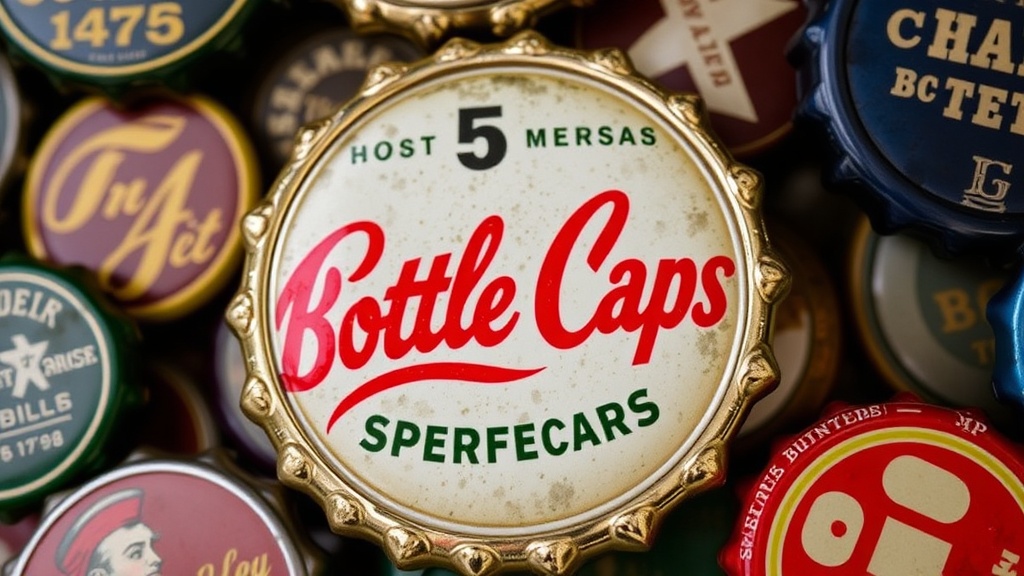
5 Rare Bottle Caps Every Collector Dreams of Finding

Pre-1960s Coca-Cola Cork Liners
Limited Edition Craft Brewery Releases
World War II Era Steel Caps
Early Plastic Liner Conversions
Error and Misprint Varieties
Why Are Some Bottle Caps Worth Thousands of Dollars?
Certain bottle caps command serious money in the collecting world — and this post breaks down five of the most coveted examples. Understanding what makes these small metal discs valuable helps you spot hidden gems at flea markets, estate sales, and even tucked away in old collections. Whether you're just starting out or you've been hunting caps for years, knowing what to look for can transform an ordinary find into a record-breaking discovery.
What Was the First Bottle Cap Ever Made?
The first bottle cap was patented by William Painter in 1892 — a crown cork design that revolutionized the beverage industry. This Baltimore inventor created what collectors now call the "crown cap," and early examples bearing patent dates or unique manufacturer marks fetch premium prices at auction.
William Painter's original crown cork design featured a corrugated metal top lined with cork. It replaced messy, unreliable methods like wired-down stoppers and changed how the world consumed carbonated drinks. Early Painter caps — especially those with 1892 patent dates — represent the holy grail for serious collectors.
Here's the thing: most collectors never encounter genuine 1890s Painter caps. They were disposable items, not keepsakes. Finding one in decent condition requires extraordinary luck — or deep pockets at specialized auctions.
The Painter Crown Cap (1892-1900)
Original Painter Manufacturing Company caps from the 1890s routinely sell for $500 to $2,000 depending on condition. The earliest examples feature simple stamped text: "PAT. FEB. 2 1892" or "PAINTER MFG. CO. BALTIMORE."
Condition matters enormously. A cap with intact cork lining and minimal rust commands double what a corroded example brings. Some collectors specifically seek "dug" caps — those recovered from old dumps or privy pits — accepting patina as historical evidence.
The catch? Reproductions exist. Modern replicas often appear too clean, too perfect. Authentic period caps show irregularities in the stamping, uneven corrugation, and age-appropriate wear patterns that decades underground create.
Which Coca-Cola Bottle Caps Are the Rarest?
Certain vintage Coca-Cola caps — particularly test market issues, employee-only designs, and early foreign variants — rank among the most valuable in the entire hobby, with some selling for over $5,000.
Coca-Cola caps represent the most collected category worldwide. The brand's global reach and aggressive marketing created thousands of distinct designs across decades. Most common Coke caps trade for pennies. A handful remain impossibly scarce.
The 1970s Australian Test Market Cap
In 1974, Coca-Cola tested aluminum twist-off caps in limited Australian markets. The trial failed — consumers preferred traditional crowns — and most production runs were destroyed. Survivors number in the dozens.
These aluminum twist-offs feature distinctive ribbed sides and a simplified Coke script. Unlike standard steel crowns, they're lightweight and prone to bending. Finding one undamaged represents a serious achievement.
Recent sales at specialized collectible auctions show Australian test caps moving for $3,000 to $5,400. Authentication is critical — the aluminum alloy composition differs from modern reproductions, and genuine examples show specific wear patterns on the twist threads.
Early Japanese Coke Caps (1950s)
Post-war Japanese Coca-Cola production used unique crown designs featuring katakana script and distinctive red-white color schemes. Occupation-era examples (1945-1952) remain particularly elusive.
These caps often show higher manufacturing quality than American counterparts of the same period. Japanese metalworking traditions produced sharper embossed details and more consistent cork linings. Collectors prize the aesthetic difference.
Worth noting: many "Japanese" Coke caps on the secondary market are actually later reproductions or Korean-manufactured items. Authentic period pieces carry specific import marks and show aging patterns consistent with Japanese climate conditions.
What Makes Military Bottle Caps Valuable?
Military-issued bottle caps — particularly those from World War II and earlier conflicts — command premiums due to their historical significance, limited production runs, and the stories they carry from specific campaigns or units.
Soldiers have always needed beverages. Before modern MREs included drink pouches, crown caps accompanied beer and soda rations in the field. Military caps often featured simplified designs, unit markings, or special "for military use only" notations that distinguish them from civilian versions.
World War II "Victory" Caps
American beverage companies produced special military-issue caps during 1942-1945 featuring patriotic slogans, V-for-victory symbols, and rationing reminders. These weren't sold to civilians — they accompanied beverages shipped to PX stores and canteens.
The "Remember Pearl Harbor" cap from 1942 Anheuser-Busch production represents perhaps the most famous example. Less than twenty confirmed specimens exist in collections. The last public sale occurred in 2019, fetching $8,200 at a militaria auction in Ohio.
That said, condition challenges plague military caps. Field conditions meant exposure to moisture, mud, and rough handling. Most surviving examples show significant wear — which actually helps authenticate them. Pristine "mint" military caps from combat zones should raise suspicion.
Regimental Beer Caps
British and Commonwealth forces developed a tradition of unit-specific bottle caps for regimental beers. The Black Watch, Royal Marines, and several RAF squadrons commissioned custom-embossed crowns featuring unit insignia.
These regimental caps rarely entered general circulation. Produced in quantities matching unit strength — sometimes just hundreds — they were consumed during mess functions and ceremonies. Finding them requires connections to military families or luck at estate sales near former bases.
The Royal Tank Regiment cap from 1944 — featuring their distinctive "Fear Naught" motto — represents a prize that advanced collectors pursue for years. Authentic examples trade privately between established collectors; they rarely appear on public markets.
Are Prohibition-Era Bottle Caps Worth Collecting?
Prohibition-era bottle caps (1920-1933) hold significant value — especially those from now-defunct breweries that never resumed production after repeal, and "medicinal" whiskey caps that exploited legal loopholes.
The Volstead Act didn't eliminate American drinking. It transformed it. Underground breweries, "near beer" producers, and medicinal whiskey distributors all used bottle caps — often with coded markings, false company names, or deliberately vague designs that protected producers from prosecution.
The "Medicinal Whiskey" Caps
Between 1920 and 1933, doctors could prescribe whiskey for various ailments. The resulting medicinal whiskey trade generated unique bottle caps — often featuring pharmaceutical-style markings, dosage warnings, and prescription notation spaces.
These caps represent a peculiar American compromise. They allowed legal alcohol distribution while maintaining Prohibition's fiction. Modern collectors value them as artifacts of institutional hypocrisy.
The Glenmore Distilleries medicinal cap — featuring a prescription blank area and "For Medicinal Purposes Only" embossed text — commands $400 to $800 depending on condition. Similar caps from smaller regional distilleries that collapsed during Prohibition fetch even more.
Here's the thing: many "Prohibition caps" offered online are actually 1930s-1940s reproductions created after repeal. Authentic period examples show specific aging patterns — corrosion types, cork degradation, and metal composition — that distinguish them from later productions.
How Do You Identify Foreign Bottle Cap Rarities?
Foreign bottle caps from specific countries, limited export runs, or political transition periods often become unexpectedly valuable — particularly those from nations with short-lived governments, collapsed breweries, or restricted export histories.
International collecting introduces complexity. A cap worth pennies in its home country might command serious money elsewhere due to scarcity, historical interest, or aesthetic appeal. Soviet-era caps, early Chinese productions, and limited African brewery issues represent particularly hot markets.
| Cap Type | Origin Period | Typical Value Range | Rarity Factor |
|---|---|---|---|
| Soviet Champagne Cap (Abrau-Durso) | 1950s-1960s | $150-$400 | State-controlled production |
| Early PRC Beer Cap | 1949-1965 | $300-$900 | Cultural Revolution destruction |
| Rhodesian Breweries Cap | 1965-1979 | $200-$600 | International sanctions period |
| East German Pilsner Cap | 1949-1989 | $75-$250 | GDR collapse documentation |
| Pre-Castro Cuban Beer Cap | 1940s-1958 | $400-$1,200 | Revolutionary destruction |
Soviet-Era Champagne Caps
Stalin famously said that life had become "more joyous" — and Soviet champagne production expanded accordingly. State-produced sparkling wine used distinctive crown caps featuring hammer-and-sickle motifs, Cyrillic branding, and specific factory codes.
Abrau-Durso — the historic Black Sea winery — produced the most collected examples. Their 1950s caps featured embossed grape clusters and vintage dating unusual for crown-cap packaging. Western collectors discovered these beauties slowly; the market developed only after Soviet collapse allowed export.
The 1955 Abrau-Durso "Stalin vintage" cap — produced the year of his death — carries particular historical resonance. Prices have climbed steadily as Russian collectors compete with Western historians for limited supply.
Pre-Castro Cuban Caps
Cuba's beer industry thrived before 1959. Cristal, Bucanero, and Hatuey breweries produced distinctive caps reflecting Art Deco and Mid-Century Modern design trends. Revolutionary nationalization destroyed most corporate archives — and deliberately eliminated pre-revolutionary branding from circulation.
Surviving caps from the Batista era offer windows into a vanished commercial culture. The Hatuey "Indian head" design — featuring a stylized Taíno chief — represents perhaps the most visually striking example. Original 1940s-50s specimens trade for $400-plus when they surface.
Worth noting: post-1990s Cuban caps flooded tourist markets, creating confusion. These modern productions feature different metallurgy, brighter colors, and crisper embossing that distinguishes them from period originals.
Where Should You Hunt for Rare Bottle Caps?
The best rare cap hunting grounds include old home sites with deep trash deposits, abandoned brewery buildings, pre-1960s rural dumps, and estate sales from long-established families — particularly those near former military bases or closed industrial facilities.
Permission matters. Trespassing for caps creates legal problems and damages collector reputation. Building relationships with property owners — offering to share finds or document discoveries — opens doors that remain closed to grab-and-go hunters.
Metal detectors help, but they won't find everything. Many valuable caps rest in locations where metal detection is prohibited or impractical. Old basements, attics, and storage sheds sometimes yield caps that surface hunting misses entirely.
The diggers' community maintains informal networks sharing information about promising sites. Joining these networks — through forums, clubs, or regional shows — provides access to collective knowledge that would take decades to develop independently.
Start with local history. County historical societies often possess Sanborn fire insurance maps showing where breweries, bottling plants, and bars operated. These maps — digitized for many regions — provide research foundations that separate systematic collectors from casual pickers.