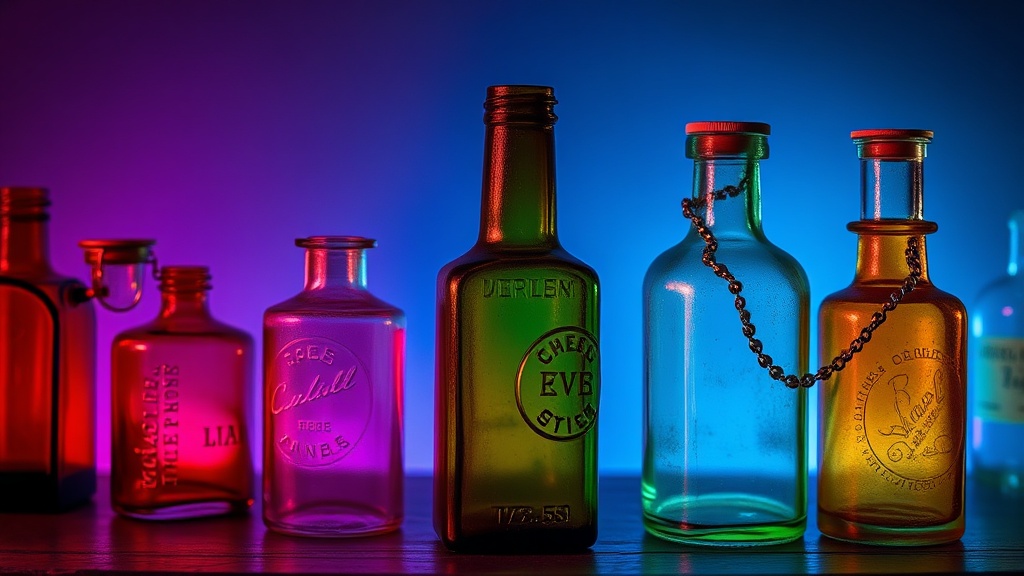
Rare Glass Colors Found in Antique Medicine Bottles

Deep Cobalt Blue
Emerald Green
Amber and Honey Tones
Amethyst Purple
Milk Glass White
Have you ever picked up a dusty, cobalt blue bottle and wondered why it looks so different from the clear ones in your collection? This post explores the specific chemical additives that created rare glass colors in antique medicine bottles, from deep ambers to the elusive aqua hues. Understanding these color variations helps you identify bottle age, manufacturer intent, and potential rarity in the field.
Collecting glass isn't just about the shape of the bottle or the embossed label. It's about the chemistry inside the molten glass itself. Most people see a green bottle and think "old," but the specific shade tells a much deeper story about what was inside—and what the glassmaker was trying to hide.
What Causes Different Colors in Antique Glass?
Different colors in antique glass are primarily caused by trace amounts of metal oxides added to the molten glass during production. These impurities or intentional additives change how light passes through the material, creating the colors we see today.
Back in the 19th century, glass makers didn't always have perfect control over their ingredients. Sometimes, a color was an accident. Other times, it was a deliberate choice to protect a light-sensitive medicine. If you're looking at a bottle with a deep, dark tint, it likely wasn't just for aesthetics. It was functional.
For instance, many apothecary bottles were made in dark colors to prevent sunlight from breaking down the chemical compounds of the medicine. This is why you'll see so much amber and cobalt in historical collections. Sunlight—specifically UV rays—can ruin a tincture or a syrup in a matter of days. The glass acts as a shield.
Here are the most common color-producing elements used in historical glass manufacturing:
- Iron: Creates the common green and "aqua" tints found in many utilitarian bottles.
- Cobalt: Produces that striking, deep blue that collectors crave.
- Manganese: Often used to neutralize the green tint of iron, resulting in a clear or slightly purple appearance.
- Selenium: Adds reddish or orange hues to the glass.
- Copper: Can produce shades ranging from green to deep red depending on the concentration.
The glassmaking process has evolved significantly, but these basic chemical principles remain the same. If you see a bottle with an unusual tint, check the base for bubbles or "seeds"—these are tiny air pockets that often indicate older, hand-blown or machine-blown glass with less refined materials.
Why Are Certain Bottle Colors More Valuable?
Certain bottle colors are more valuable because they represent rarer chemical combinations or were produced in much smaller quantities for specific, high-end medicinal uses. While clear glass was the standard for most household goods, specialized colors often signaled a premium product.
Cobalt blue is a classic example. While not unheard of, a high-quality, deep cobalt bottle with no imperfections is a staple for any serious collector. It stands out on a shelf. But don't ignore the subtle colors. A "machine-made" clear bottle is often worth very little, but a hand-blown bottle with a slight "amethyst" tint from manganese can be a treasure. (Keep an eye out for that purple tint under a UV light—it's a dead giveaway for older glass.)
The value often hinges on the intersection of color and utility. A bright red glass bottle used for a specific tonic is much rarer than a standard brown amber bottle used for general medicine. The scarcity of the pigment itself drives the price up in the secondary market.
To help you categorize what you're finding, I've put together a quick reference guide for common antique colors and their likely origins:
| Color Name | Common Source | Collector Value Note |
|---|---|---|
| Cobalt Blue | Cobalt Oxide | High; very popular in apothecary collections. |
| Amber | Iron/Sulfur | Standard; common for light-sensitive liquids. |
| Aqua/Light Green | Iron Impurities | Moderate; depends on the bottle's age and shape. |
| Amethyst/Purple | Manganese | High; often indicates an older, unrefined glass. |
| Deep Emerald | Chromium/Iron | Variable; can be quite rare in specific shapes. |
That said, don't get blinded by a pretty color. A common shape in a rare color is still just a common shape. Always look at the embossing and the lip of the bottle first. The color is the "wow" factor, but the provenance and manufacturing method are the real indicators of worth.
How Can You Identify Authentic Antique Colors?
You can identify authentic antique colors by examining the glass under different light sources and looking for specific physical characteristics like "seeds," "striations," or "bubbles" that are characteristic of older manufacturing methods. Modern glass is often too perfect, which is a red flag for collectors.
One trick I use is to hold the bottle up to a strong, natural light source. If the color looks uniform and "flat," it might be a modern reproduction. Antique glass often has slight variations in color density due to the way the chemicals mixed in the furnace. It’s rarely a perfect, solid tone from top to bottom.
Watch out for "sun-purple" glass. This is a phenomenon where manganese, used to clear the glass, reacts to long-term UV exposure and turns the bottle a faint purple. This is a hallmark of genuine antique glass. If you see this, you're likely looking at a piece that has been sitting in the sun for decades—or even a century.
Here is a checklist to use when you're out in the field or at an estate sale:
- Check for "Seeds": Are there tiny air bubbles trapped in the glass? (Old glass is bubbly; new glass is usually clear.)
- Inspect the Base: Is the bottom smooth or does it have a "pontil mark"? A pontil mark is a scar left from a glassblowing tool.
- Use a UV Light: Does the glass fluoresce or show a purple tint? This helps confirm the presence of manganese.
- Examine the Color Gradient: Is the color consistent, or are there slight shifts in shade? Natural variations are a good sign.
- Feel the Weight: Antique glass often feels heavier or more substantial than modern, thin-walled glass.
If you're ever unsure, check the Library of Congress digital collections or similar historical archives. They have incredible high-resolution images of historical pharmaceutical packaging that can serve as a great baseline for your comparisons.
It's easy to get caught up in the excitement of finding a "rare" color, but stay grounded. A lot of what we call "rare" is actually just "unusual." A deep red bottle might look spectacular, but if it was mass-produced in the 1950s, it's not a true antique. Always verify the era of the bottle's design before you decide it's a centerpiece.
One thing to remember: the color is part of the story. If you find a dark green bottle, don't just see a green bottle. See a vessel that was designed to protect a volatile chemical from the sun. That context is what turns a simple object into a piece of history.
The next time you're digging through a bin or browsing an antique mall, don't just look for the labels. Look at the light passing through the glass. The color is telling you exactly how that bottle was made and what its purpose was in a world before modern plastic and stable chemicals.