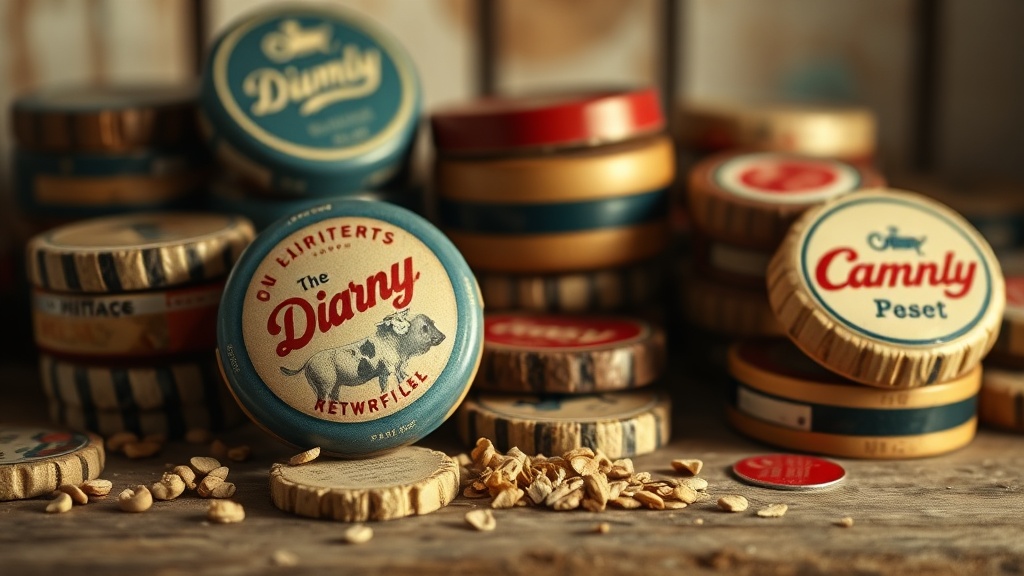
Why Vintage Dairy Caps Are More Than Just Cardboard Scraps

How do you tell if a vintage milk cap is actually rare?
Most folks look at a stack of old cardboard milk caps and see nothing but recycled paper that should've stayed in the bin decades ago. They're wrong. These aren't just scraps; they're "smalls" that capture a specific moment in local history when every town had its own dairy and every morning started with a glass bottle on the porch. This guide breaks down how to identify rare regional variants, what makes a specific cap valuable to a collector, and why the "pull-tab" design changed everything for the hobby. Understanding these nuances matters because the difference between a nickel cap and a fifty-dollar find often comes down to a single line of misprinted text or a defunct dairy's logo.
Don't expect to find a fortune in every shoebox of caps. The market for these items is niche but surprisingly deep. We aren't talking about mass-produced modern replicas found in gift shops. We're looking for the authentic discs that once sat atop glass quart bottles in the 1920s through the 1950s. The thickness of the cardboard is your first clue—older caps tend to be sturdier, often with a waxed finish that helped them survive the moisture of a milk crate. If the cardboard feels flimsy or looks like modern bleached white paper, you're likely holding a reproduction designed for a hobbyist's craft project rather than a piece of history.
Where can collectors find authentic early 1900s dairy memorabilia?
While eBay is the obvious choice, it's also a breeding ground for overpricing. The real gems are found at regional bottle shows or through specialized organizations like the Federation of Historical Bottle Collectors. These events allow you to handle the items, check the weight of the cardstock, and verify the scent (yes, old milk caps shouldn't smell like modern chemicals). Local estate sales in older neighborhoods are another goldmine, especially if the previous owner was a "saver" who kept things in dry, dark attics. These are the places where you'll find the rare survivors that haven't been picked over by ten other dealers first.
The mechanical evolution of the cap is a story in itself. Before the mid-1930s, most caps were flat discs that required a sharp tool—or a very steady fingernail—to pry out. This was a mess waiting to happen. The introduction of the "stapled pull-tab" was a revelation for the housewife balancing a heavy glass bottle. These caps have a tiny wire staple holding a small paper tab. If you find one where the tab hasn't been ripped or bent, you've found something special. Collectors distinguish between "standard" (no tab), "staple-tab," and "die-cut tab" (where the tab is part of the cardboard disc itself). Each variation represents a different era of manufacturing technology, and serious hobbyists often try to find one of each style for a specific dairy.
What factors determine the market price of a cardboard bottle cap?
Beyond rarity and condition, the visual appeal is massive. Collectors love graphics. A plain cap with just the dairy's name is fine, but a cap featuring a stylized cow, a delivery truck, or a 1940s-era "healthy child" illustration will always command more attention. Some enthusiasts specialize entirely in these "pictorials." There's also the "slang" factor—caps that use old-fashioned terminology like "Vitamin D Fortified" in unique fonts or those that mention specific breeds like "Guernsey" or "Jersey" milk. These details give a window into the marketing wars of the mid-century dairy industry.
Condition is the second pillar of value. Unlike metal bottle caps that rust or dent, cardboard caps suffer from "foxing"—those little brown age spots—and edge wear. A cap that's never been pushed into a bottle (called "new old stock") is the gold standard. If you see a clean, unpunched tab, you're looking at a premium item. Even a slight crease across the middle can slash the price by seventy percent. It's a brutal market for perfectionists, but that's what keeps the high-end trades interesting. Check this table for a general idea of how we think about grading these items.
| Grade | Characteristics | Value Impact |
|---|---|---|
| Mint | No creases, no foxing, bright colors | 100% of Market Value |
| Fine | Minor edge wear, slight fading | 60-75% of Market Value |
| Good | Visible creases, some staining | 10-25% of Market Value |
Let's talk about the regional connection. In my area, dairies like Crescent and Modern Dairies ruled the roost. Their caps are relatively common here but can be "exotic" to a collector in another province or state. This regionality creates a fascinating swap-culture. You can trade three common local caps for one rare out-of-town piece if you find the right partner. It's a way to expand your collection without spending a fortune at auctions. Always keep an eye out for "pre-standardization" caps that might be slightly larger or smaller than the typical 1-5/8 inch diameter. These were used for specialty bottles like creamers or large jugs and are significantly harder to come by.
Don't overlook the "filler" caps either. Even the common ones have a place in a well-rounded display. They provide context for the rare pieces. If you've got a dozen standard caps from a city like Winnipeg or Chicago, that one "Gold Medal" variant stands out much more than it would in isolation. It's about building a narrative of how the dairy industry evolved from local family farms to the industrial giants we see today. You can see more about the glass these caps protected at the National Bottle Museum, which helps put the "small" side of the hobby into perspective.
Displaying these requires more thought than just tossing them in a jar. Light is your biggest enemy. Those bright reds and deep blues on the cardboard will fade into a muddy grey if left in direct sunlight for even a few months. Professional collectors use acid-free archival sleeves to keep the caps flat and protected from skin oils. If you're going to use a frame, make sure it has UV-protective glass. I've seen entire collections lose half their value because they were mounted on a sunny wall in a "vintage" kitchen. It's heart-breaking to see a rare 1920s cap bleached white by the sun.
Just like in coin collecting, errors can drive prices skyward. A cap where the colors are shifted—a red cow with its head two millimeters to the left of its body—is a curiosity that some people live for. Double-strikes, where the text is printed twice, are even rarer. Because these were cheap, disposable items, the quality control wasn't exactly top-tier. Most errors were simply tossed at the factory, so the ones that survived to reach a consumer's doorstep are genuine anomalies. They're the kind of things that make a collection feel unique rather than just a checklist of known items.
When you're cleaning these (or rather, not cleaning them), remember that moisture is the enemy. Never use water on cardboard. A soft, dry brush is all you need to remove surface dust. If there's a stubborn stain, it's better to leave it than to risk ruining the paper layers. Many a great collection has been ruined by a well-meaning beginner with a damp cloth. Just leave the history as you found it and focus on finding the next piece of the puzzle at a local show or through a trusted seller like Dairy Antiques. Whether you're hunting for that one missing piece of a regional set or just starting out with a handful of discs found at a flea market, the process is as much about the hunt as it is the cardboard itself.